Showing posts with label search engine marketing. Show all posts

Researching Fiverr Search Trends: Strategic Keyword Management 101

Recently, Fiverr posted a list of the top searches from the platform, and legendary ebiz myth-buster, Niall Doherty listed out the top 6 in his eBiz Weekly newsletter. The reason that Fiverr posts these is so that "you can successfully promote the most up-and-coming services to your audience" (Fiverr).

Of course, avid keyword researchers know that this is only half of the story. Like all destination sites (Amazon, Facebook, LinkedIn, news sites, etc.) Fiverr is partly a search engine and partly content creator and as such whether the pages index well by Google (and others) actually matters.

Now, beyond offering Fiverr gigs, there are also opportunities to offer services such as PLR, deep-dive keyword research and so on to people actually doing the work. For example, people offering photoshop editing are often on the lookout for ways to pull in more customers, and a list of well researched and keyword rich hot topics would be a worthwhile investment to them.

It also should come as no surprise that even if Fiverr is being used as the collection and rating agency for many freelancers, they often have their own pages where they promote their gigs. In both cases, organic traffic (from 3rd party search engines) is likely to be important.

When we would like to know, is of the top 6 keyword phrases, which ones are global, and which ones are local to Fiverr. This helps make sure that our research is on point, and that we select the correct market profile: are we selling gold, or are we selling shovels to dig for gold?

The first step is to establish where Fiverr gets its traffic.

Fiverr Traffic Sources

According to SimilarWeb, Fiverr gets around 68% from direct links (i.e. people typing in fiverr.com or linking to a fiverr.com page directly), with a further 20% coming from search engines. The remaining 12% is split between social and mail (just under 11%) and display advertising and referrals (just over 1%).

The search engine traffic is about 75/25 in favour of organic over paid keyword advertising. Social is split between YouTube (roughly half), Facebook (about 1/5th) and the rest is Pinterest (7%), WhatsApp  (5%) and Twitter coming in at about 4%.

From this brief data-gathering exercise, we can see that the strategy appears to be heavily weighted towards on-site search, or affiliates directly linking into their gigs from their own pages.

This is backed up by Ubersuggest's domain report for Fiverr, which notes a backlink count of around 50 million, with about 7 million no-follows. That's 50 million links into Fiverr from sites other than search engines.

That said, Ubersuggest also notes that Fiverr ranks for around 1.7 million organic keywords. Clearly, these aren't all going to be permutations of Fivver, gig, paid gig, freelancer, and so forth, so it is likely that the keywords surfaced by their internal stats will also be indexed by the search engines.

Therefore, our in is to provide ways for Fiverr affiliates to produce content that enables them to rank well outside Fiverr, rather than giving them PLR to sell inside Fiverr to their customers.

Q3 Fiverr Keyword Trends

For the record, and repeated from Niall Doherty's article, here are the six keyword phrases in question:

  • twitch emotes
  • social media management
  • photoshop editing
  • voice over
  • content writer
  • NFT

All of these are, or were, trending on the Fiverr platform, in Q3 2021. Here's how they performed organically:

twitch emotes trends 2014 to 2021
Twitch Emotes

The data from 2004 to 2014 is excluded since it is a flat zero line. The trend line since then would seem to suggest that the wider demand for "twitch emotes" has passed. Combining the rising and top keyword queries from Trends, sample keyword phrases include:

  • twitch emotes maker
  • top twitch emotes
  • how to make twitch emotes
  • free twitch emotes
  • how to get twitch emotes


social media management trends 2009 to 2021
Social Media Management

From the above graph, social media management would appear to be a trending topic in Trends that is also trending organically in search engines at large. By way of example, here are the top 5 rising keyword queries related to social media management:

  • best social media management companies
  • social media management price
  • personal social media management
  • social media management for small business
  • best free social media management tools
The sentiment that this is a rising trend is backed up by the fact that there are plenty of related keyword phrases (25/25 in Trends Top Queries and 20/25 in Rising Queries). Quite a few of the Breakout rising phrases are geared towards geographic locations, too, which makes for easy reuse, by region, of content created for Fiverr affiliates.

photoshop editing trends 2009 to 2021
Photoshop Editing

The peak organic search volume for photoshop editing appears to have been somewhere in 2017, with quite a big drop-off in 2019 that hasn't really recovered. The top related queries revolve around the following topics:

  • background [hd] images for photoshop editing
  • background images for photoshop editing free download
  • online photoshop editing
  • photoshop editing tutorials
It's also worth noting that there are fewer related keywords reported by Trends (13/25, or 52%) than one might expect for a keyword phrase that has been around since the beginning of Trends records. This also goes some way to supporting the theory that organic searches have stagnated somewhat, and is backed up by the fact that there are also only two rising queries reported by Trends.

voice over trends 2009 to 2021
Voice Over

Not only is the trend line for voice over flat, it is also hovering around 25% of its peak, which occurred in mid-2004. The top related query is for voice over jobs, and there is some confusion in the results between voice over as a technology (voice over IP) or as a service (voicing over video). Here are the top 5:

  • voice over jobs
  • voice over ip
  • voice over video
  • voice over iphone
  • voice over artist
An educated guess would be that Fiverr affiliates are more in the voice over as a service category, rather than technology. For the curious, there's also a distinction between "voice over" and "voiceover":


voice over vs voiceover trends
"Voice Over" vs "Voiceover"

The other obvious query - "voice-over" - was even less popular than the red-labelled "voiceover". There might be some space to help out Fiverr affiliates in this topic, but be prepared to weed out a lot of tech-related red herrings.


content writer trends
Content Writer

Another topic that is on the ascendency across search engines, and not just on Fiverr, content writer has a number of very interesting rising queries revealed by Trends:

  • content writer near me
  • arabic content writer
  • content writer wanted
  • saas content writer
  • web content writer

All of the above, with the exception of "web content writer" are also Breakout queries, meaning that the comparable volume is so far beyond the others as to be considered trending very highly. However, the trend lines for these indicate that the market may be smaller than the overall trendline suggests. Here are the top 5 related queries (based on the last 12 months) for comparison:

  • content writer job[s]
  • freelance content writer
  • content writer salary
  • what is content writer
  • website content writer

There are some solid possibilities, but the overall sentiment is that it will be pretty competitive for both the Fiverr affiliates selling into the market and any content strategists vying to help them.
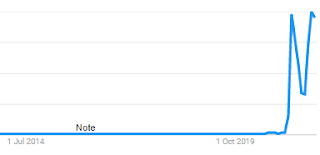

nft trends
NFT

Quite what people expect to find on Fiverr when they search for "NFT" isn't clear. It feels unlikely that $5 will buy you something that you can turn into an NFT that can be exchanged for *gulp* millions, but reading articles such as this one from CNBC about a boy who made a small fortune from Weird Whales proves that anything is possible.

From the chart, the newness of NFT as a search term is obvious. However, it also has 25/25 rising queries in Trends, and 25/25 top queries, which hints that it may be more than a flash in the pan. Here's the top 5 rising queries that mention "NFT":

  • opensea nft
  • nft games
  • nft art finance
  • what is a nft
  • how to buy nft

There are plenty more, and they are all Breakout. If you are a techie, who knows about NFTs, and you can find an angle on Fiverr, this is the one that I'd be pushing: offering content to affiliates providing NFT services.

I'll see you there, selling pickaxes and not gold.

Summary

The above is a very brief skim across the top, as a demonstration of how you should treat strategic keyword research when considering either helping existing freelancers on a platform like Fiverr. Remember that it's far easier to sell shovels, picks, and denim workwear than it is to mine a diamond or chunk of gold.

Please reach out in the comments below to discuss any of the above, or request a one-on-one session to explore keyword research and content strategies for your own projects.

Sources & Resources


Monday, 2 January 2017

3 Hot SEO Topics You Missed in 2016!

One of the perennial SEO tasks that hits in January is the usual debate over which of the hundreds of search signals you should pay attention to for the coming year.

2016 has been interesting for a lot of reasons, and in search there have been some trends that might have passed you by.

Firstly, though, I'd like to pull out the usual advice that I give clients in January: make a search engine marketing plan. That includes, as always, three things that you didn't do last year, and will do this year, and disposes of three things that didn't work out.

If tyou don't find three things that didn't work out, then either you weren't paying attention, or you haven't been tracking your SEO and SEM activities.

At least that gives you something to put on the 'To Do More Of' list in 2017.

Here's the three things that are most common to my search clients for 2017 and which everyone should continue to do, or start doing in earnest.

Mobile & Local


Right off the bat, making web pages mobile friendly has to be a priority if, like many, you have sidestepped the topic over the past year.

It's more than just moving to a responsive theme on your blog; embracing mobile properly also means:

  • checking the mobile-friendliness of advertising network partners;
  • double-checking plug-in mobile compatibility;
  • creating content with mobile in mind, selectively published for mobile devices.

This last goes hand in hand with local search.

There are a lot of searches that tend to be done on mobile platforms that are also local. The image I like to use is that of a person in the street, using their mobile device to compare prices and make bookings for beauty treatments at neighbouring, competing salons.

It happens. It will happen more frequently in 2017 than 2016, so get used to it.

User First


For 2017, everyone needs to put their users (readers, customers, clients or audience) first in their SEO and SEM activities.

Not the search engines. There are still too many people who look at this as a technology issue, when it isn't any more. The symptom is putting search engines first (i.e. white hat optimisation and near keyword-stuffing) and the cure is user-first SEM.

That means:

  • better content;
  • responding to needs;
  • testing the balance of information-to-sale.

The first one is easy. Have a content plan, based on keyword research, using the full plethora of tools available, and apply it every step of the way. Make it interesting, personal, and relevant.

That means responding to the needs of the audience. If video works best, give them video. If it's how-to PDF files they're after, then create a content plan around that. Check out the questions they are asking, and then give them best-in-class content to answer the questions, and a best-in-class product to go with it.

Of course, that means paying attention to tracking results. It's time to install trackers, pay attention to Search Console and Analytics and make sure you know what works every step of the way, and then replicate it across the content delivery platform.

Keyword Research for RankBrain


Google's gotten smarter in 2016.

The introduction of RankBrain means that your content has multiple meanings to a search engine. The best bit about this is that you don't need to create different pieces of content for different audiences, when they are semantically close in search space.

The slightly troublesome aspect is that you should be a lot more attuned to concepts for your content, and concentrate much less on exact words to represent it.

Yes, you can still use keyword research to uncover your audience's needs, but when it comes to content creation, use the full richness of language to get your ideas across, rather than trying to target a single phrase. It's a tricky balance, but with practice one that is fairly easy to get right.

So, as you go into 2017 with your content marketing plan rolled up under your arm, keyed to topics that you have proven will attract traffic, just remember that it's about the end user, not trying to get free organic traffic at any cost to quality content delivery.

If you want one-on-one help building a search engine marketing plan for 2017, then please use this form to request a free web site evaluation.

Thursday, 8 December 2016

Keyword Research for Hotel SEO Strategy

With direct bookings both more profitable and becoming more frequent, it pays to have a keyword research and SEO strategy specifically tailored to the hospitality industry. There are two drivers for this:

  • Search engines become smarter and attuned to local search;
  • Consumers becoming more comfortable booking online.

While sites like TripAdvisor and Expedia are also key to a hotel's success and cannot be ignored, more and more consumers are turning to Google first to find their perfect getaway location.

Along with some excellent advice in the Hospitality Net article "How to Jumpstart Your Hotel's Direct Bookings Through Search Engine Marketing" there are some surprising figures to back this up. According to the article 61% of potential customers come through a search engine with a 20% year on year increase in relevant searches performed on Google.

This would indicate that SEO is going to be a deciding factor in a hotel's long-term direct booking success.

Hotel SEO Strategy 


While it is entirely possible to reduce the SEO process through concentrating on "7 Steps for Your Small Business Survival" (NuWireInvestor web site) including local search, social engagement and creating attractive, valuable content, many experts seem to gloss over the keyword research strategy as part of the marketing process.

Search engine optimisation (SEO) and search engine marketing (SEM) both rely heavily on an integrated keyword management strategy, and so it is surprising that it doesn't seem to get the emphasis that it richly deserves.

For example: while a long tail keyword research policy can help identify a good starting point for SEO and SEM activities, unless it becomes part of a test, measure and adjust cycle the research will always be second hand.

Keywords are the communication conduit between your target market and your hospitality offering, so properly researching them ought to be a priority: and conducted by a keyword research specialist rather than consigned to being merely part of the SEO/SEM process.

Keyword Research for Hotels


For those who have the time and confidence to go it alone, here are a few salient tips from the trenches of keyword research strategy.

Firstly, local search is highly important. Search engines can not only deal with hyper specific local searches (such as "hotel near <landmark> in <city>") but also there is a rise of the "near me" syndrome: as in "hotel near me".

However, this last is also very location-specific, so the key takeaway here has to be to remember to use geographic targeting when researching keyword usage using a tool such as the Keyword Planner.

There is a big difference between a search conducted locally ("hotel near me") and a search conducted for a location ("hotel near new york grand central station"), and this difference needs to be reflected in the SEO/SEM strategy and in the keyword research.

Next, review local restaurants, landmarks, museums, events and places of local interest in order to generate useful, valuable, attractive content, but make sure you concentrate on those that qualify in one of two ways:

  • high search volume
  • long-tail low-traffic low-competition

The first is obvious; it takes very little effort to create a piece of content highly optimised towards a very popular attraction, and if it has a very high number of requests you may find yourself with a (small) piece of a large traffic pie.

The second might not be so obvious. However, if your hotel is the only one where a visitor from out of town can get a great idea of what the event (restaurant, attraction, landmark, etc.) has to offer, then you will naturally score highly and attract high conversion rates.

Finally, remember to go for social sharing and engagement with other local businesses. For example, consider writing a piece that is highly optimised towards your chosen long tail keywords (i.e. "hotel near conference center in miami with sauna" -- I made that up, by the way!) and encouraging other local businesses to publish it, and link out to your site from theirs.

At the same time, use social keyword research to find out what conversations people are having about hotels and facilities in your area, and then jump in on the conversations with opinion (and links to your hotel booking facility) as well as using that keyword research to fuel content creation.

All of this takes time, granted, but is worth the extra effort. While The Keyword Coach has some very reasonable plans (you can take us for a test drive for $5!), there's no reason why computer literate, internet savvy hoteliers with time on their hands can't use the information in our keyword research and SEO tutorials to make a start on their own.

Just remember: Research, Test, Track, Adjust.

Sunday, 4 December 2016

How To Use Keyword Research to Get More Sales

Most (if not all) business owners would like to get more sales: online, or offline, sales are what drives a business forward.

Sometimes it doesn't take many sales -- high ticket items that command a high price point can generate a healthy income with one or two sales a month -- but all businesses rely on having paying customers.

There are three keys to making more sales:
  • finding more potential customers;
  • converting more potential customers;
  • selling more to existing customers.
Keyword research can help each of the above; it's all about knowing where to find your market, how to communicate with them, and then how to keep them interested.

Using Keywords to find Potential Customers

Potential customers (those who are willing to buy) use keywords differently to those who are just looking for information.

For example, they will be using terms like "how much" or "where to buy", as well as geographic trigger words such as city names. All of these indicate a person ready to buy, as opposed to someone merely researching.

Brand and model names are also useful indicators, especially when combined with words such as "versus" or "reviews".

Keyword research helps to isolate phrases that can be used to create content designed to pull in potential customers via the SERPs (search engine result pages) rather than merely appealing to everyone.

There will be fewer hits, but conversion rates should be higher.

Converting Visitors into Customers using Keywords

One of the highest converting complementary keywords is "free".

It is an emotional trigger word, as well as a way to convey the idea that the prospect is getting something for nothing.

However, in some circles it can also devalue your product offering; and there are even people who wouldn't even count a person who has downloaded a free gift as a customer at all.

So, although the word "free" crops up repeatedly in keyword research, it's unlikely to be a great indicator of a potential paying customer, unless you can find a way to convert them down the line.

But, it's an important first step; since even the act of downloading something and reading it requires some effort: it might have been zero cost in monetary terms, but it has cost effort and as such these people are to be considered customers.

Keyword research can also be used to reveal what non-free keywords your potential customers are looking for. Using those keywords in your text ought to help convert them into customers because you are participating in a conversation that they are already having with themselves.

Leverage Your Customer Base with Integrated Keyword Research

Every contact with existing customers -- those who have put their hands up by buying from you or downloading something from your site -- should be geared towards a Call to Action (CTA).

The more that your customers can be encouraged to engage with you, the more they will spend.

Provide a search function on your site; and integrate the keywords searched for with your regular keyword research activity. This way you will leverage their engagement to yield new avenues through which you can provide them even more value.

After all, that's all that you are trying to do with your search engine and keyword marketing: find out what the market needs, how they are trying to locate products to satisfy those needs, and providing them with the best solution on the market.

Anything less will not provide a basis for long term competitive advantage, and making keyword research part of that competitive advantage should be one of a business' strategic plan. 

For a more detailed look at how keyword research can help to get more sales, check out how answering these three questions that can triple your bottom line!

Friday, 2 December 2016

The Rise of Guided Search and Autocomplete

In a recent article "The Rise of Organic Search", Equities.com writer Brian Bridges of Lumentus pointed out that "majority of every company’s website traffic now comes through organic search". While this might not be news to hardened SEOs, it raises a couple of important points related to autocomplete, which I call guided search.
  • The first is that there is a decline in the hit rate on destination sites; places where you know the URL and type it in directly to the address bar;
  • The second is an anticipated rise in finding brands and companies by sentiment and intent rather than by a purely factual search query.
Explaining these phenomena is not trivial, but has its roots in the advent of autocomplete, a feature offered by virtually all search engines.

What is Autocomplete?

Autocomplete is a deceptively simple service: it merely suggests search terms that the user might be about to type based on previously used search terms, and the user's own input.

However, one has to wonder what the proportion of autocomplete to organic search actually is. 

While Google doesn't provide any statistics, autocomplete behaviour coupled with the claim by Bridges that "77% of users only click on the first three links" of a results page, could well be distorting true organic search in favour of something I call guided search.

The Rise of Guided Search


There are two places that Google (for example) suggests keyword phrases for users to pick as their search term.

The first is in the box that appears under the search term box, and is a result of typing a term into that edit field. This is the traditional autocomplete or auto-suggest location.

Users can simply click one that was either the term they were looking for anyway (the convenience argument), or pick one that looks interesting. The latter is an example of guided search, and it comes with the risk of contamination of the user's original intent.

The other location is under the first set of (usually 10) results, as a double-column wide list of suggested searches, which the user is free to pick from. Again, this could be argued as helpful, or convenient, but is also a good example of a guided search.

It's the same for retailers such as Amazon, who routinely suggest extra items that the customer might be interested in: that could be termed "guided shopping".

Why is this Important?


Guided search, at its worst, leads to a kind of mob mentality when it comes to finding online resources.

It's a feedback loop of sorts, rather like the kind of feedback loop you get when you use only those keyword phrases identified in your log files to create new content. It's only a matter of time before two things happen:
  • you start to repeat yourself;
  • you paint yourself into a (popular) niche.
Guided search suffers from the same issues. The more search users click on the first, second or third proposals the engine makes, the more that engine reinforces its opinion that these are things that people are searching for -- to the exclusion of everything else.

It can't be helped, and the best that we can do is anticipate the effect of guided search by using keyword research.

How Does Keyword Research Help?


If you type in your brand or company name, Google (for example) will suggest various options to elaborate the search, and these options represent queries that have been previously executed by search users.

They can be captured manually, simply by going to the search engine and performing the queries; but it is much more efficient to use a tool such as KeywordTool.io to reveal en masse the various combinations of keywords that have been used with your brand.

On the one hand, it's a good way to gauge both sentiment and intent by seeing what words are used in combination with the brand, and the brand's product lines.

Alternatively, it 's an excellent way to see what people are searching for, so that you can react to it.

Taking this one step further is the AnswerThePublic service; which specifically links questions, sentiment and intent through matching your root keyword phrase with various question-words (what, where, why, etc.) and prepositions.

Evaluating the results is an important part of maintaining your brand identity and reputation.

To learn more about keyword research, head over to the Keyword Research & SEO Tutorials page, and learn the ins and outs of running complete keyword research campaigns for your brand.